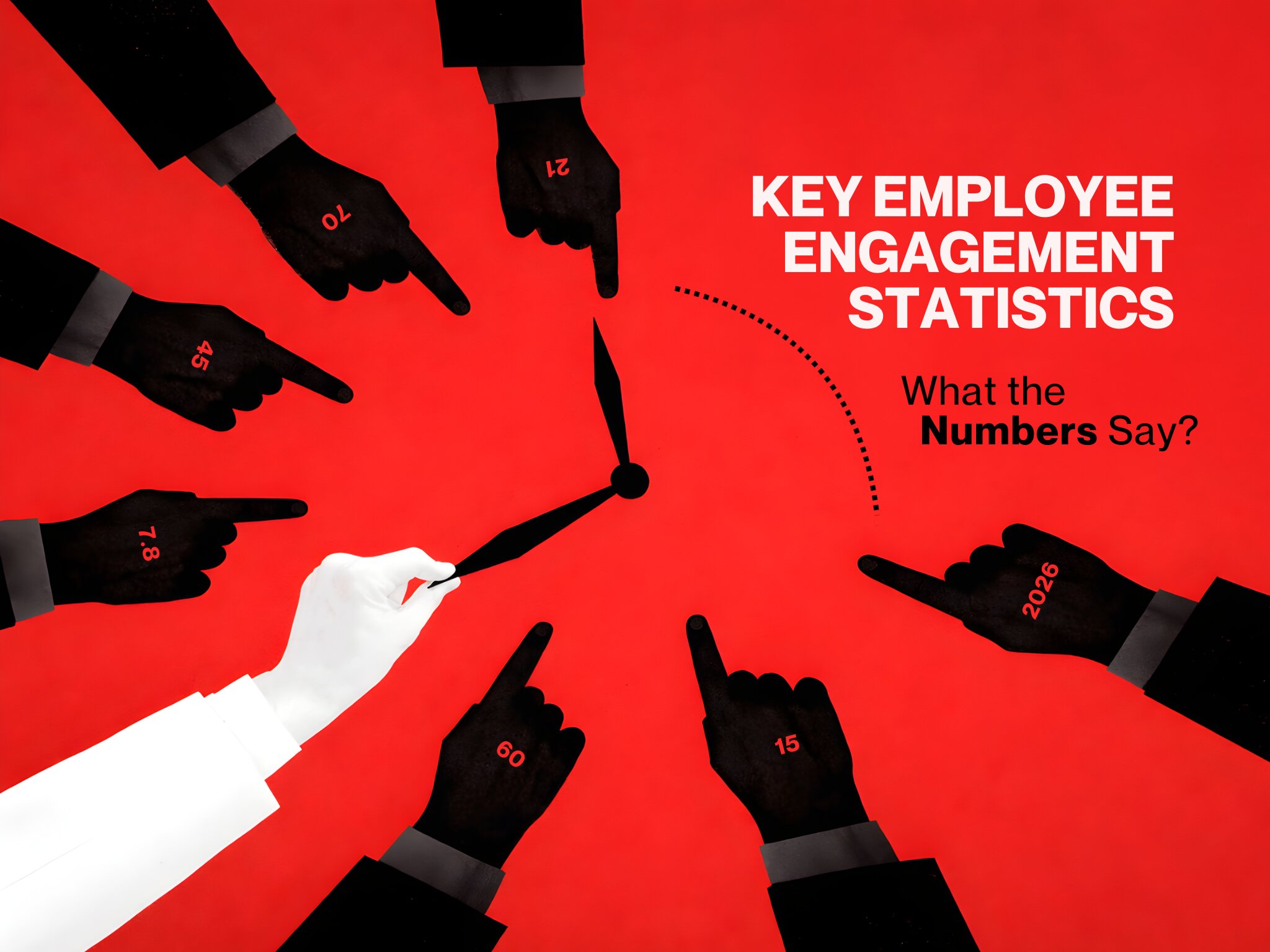
In 2026, employee engagement is no longer a ‘culture topic.’
It’s a leadership performance signal.
When engagement weakens, it doesn’t announce itself with complaints or exits.
It shows up as drag.
Decisions slow down.
Energy dissipates.
Execution requires more effort for the same outcome.
Leaders often misread this as a motivation problem.
It isn’t.
It’s a design failure.
Employee engagement today reflects how leadership systems are built, how decisions move, and how ownership is distributed. The numbers make this uncomfortably clear.
The 2026 Engagement Landscape - What the Numbers Say
Employee engagement statistics in 2026 are not trends to observe.
They are diagnostics to confront.
Across industries, the signals remain consistent:
Only 21% of employees worldwide are engaged at work, according to Gallup's State of the Global Workplace report
Gallup research finds that managers account for about 70% of the variance in team engagement
Many employees feel emotionally disconnected from their work, and it shows up long before anyone resigns
Gallup estimated in 2022 that low engagement costs the global economy $7.8 trillion a year
These figures don’t describe workforce attitude.
They describe leadership architecture.
When engagement collapses at scale, it’s rarely because people don’t care.
It’s because clarity, trust, and ownership were never designed into the system.
Why Employee Engagement Is Now a Leadership KPI
Employee engagement used to be buffered by HR.
That buffer is gone.
In 2026, employee engagement and empowerment rise or fall together, and both land squarely on leadership.
Disengaged teams are not under-skilled.
They are under-led.
The strongest correlation isn’t compensation or perks.
It’s proximity to leadership clarity.
Look at the patterns:
Who people rely on for clarity
How often decisions change without explanation
What leaders choose not to confront
Engagement is now a lagging indicator of leadership quality.
And leaders can no longer outsource responsibility for it.
The Five Engagement Metrics That Drive Results in 2026
The most effective employee engagement metrics today don’t measure sentiment alone.
They measure structural health.
Decision Velocity
How quickly can teams make and execute decisions without escalation?Ownership Density
How many people own outcomes without reminders or approvals?Manager Trust Index
Do people feel safe surfacing problems before they become expensive?Role Clarity Score
Are expectations explicit, or is effort substituting for clarity?Retention of High Performers
Not overall attrition, but who exits despite stable performance metrics?
When these metrics decline, no engagement program will fix the issue.
The problem lies in leadership design
What’s Working Now - Data-Backed Engagement Drivers
The latest trends in employee engagement are not additive.
They are subtractive.
What consistently works in 2026:
Purpose replacing perks
Frequent, real conversations instead of status updates
Leader presence instead of leadership broadcasts
Development tied to identity, not titles
AI used to surface signals, not automate care
The best employee engagement activities no longer feel like initiatives.
They feel like flow.
When engagement improves, it’s usually because friction was removed, not because motivation was injected.
The 2026 Engagement Playbook for Leaders
Most disengagement is silent.
Leaders keep missing it because it doesn’t look like failure.
It looks like work is getting done.
Delegating culture to HR
Assuming technology replaces trust
Ignoring weak signals until attrition confirms them
Common failure points include:
One-size-fits-all perks
Unclear accountability
Delayed feedback
Polite compliance masking resistance
In one fast-growing fintech firm I coached, execution looked strong on paper.
Over 60% of employees were hitting targets.
Yet fewer than 15% would recommend the company.
That was not performance.
It was compliance without commitment.
Four top performers exited within a single quarter.
Disengagement is invisible until it becomes expensive.
Trends Shaping the Future of Engagement
Looking ahead, engagement will be shaped less by programs and more by structure.
Key shifts already underway:
Engagement audits replacing annual surveys
Managers trained as decision architects, not morale officers
AI highlighting risk patterns, leaders must act on
Smaller, sharper teams with clearer ownership
Fewer initiatives, stronger operating rhythm
The future of employee engagement belongs to leaders who design systems that don’t rely on constant pressure to perform.
From Metrics to Meaning
Employee engagement in 2026 is not about morale.
It is about leadership design.
Clarity, ownership, and trust are not cultural ideals.
They are operational standards.
When leadership systems are sound, engagement is a byproduct.
When they are not, no initiative can compensate.
This is the work Rajesh Nagjee focuses on. He helps leaders move from tracking engagement to architecting leadership systems that make engagement durable, even under pressure.