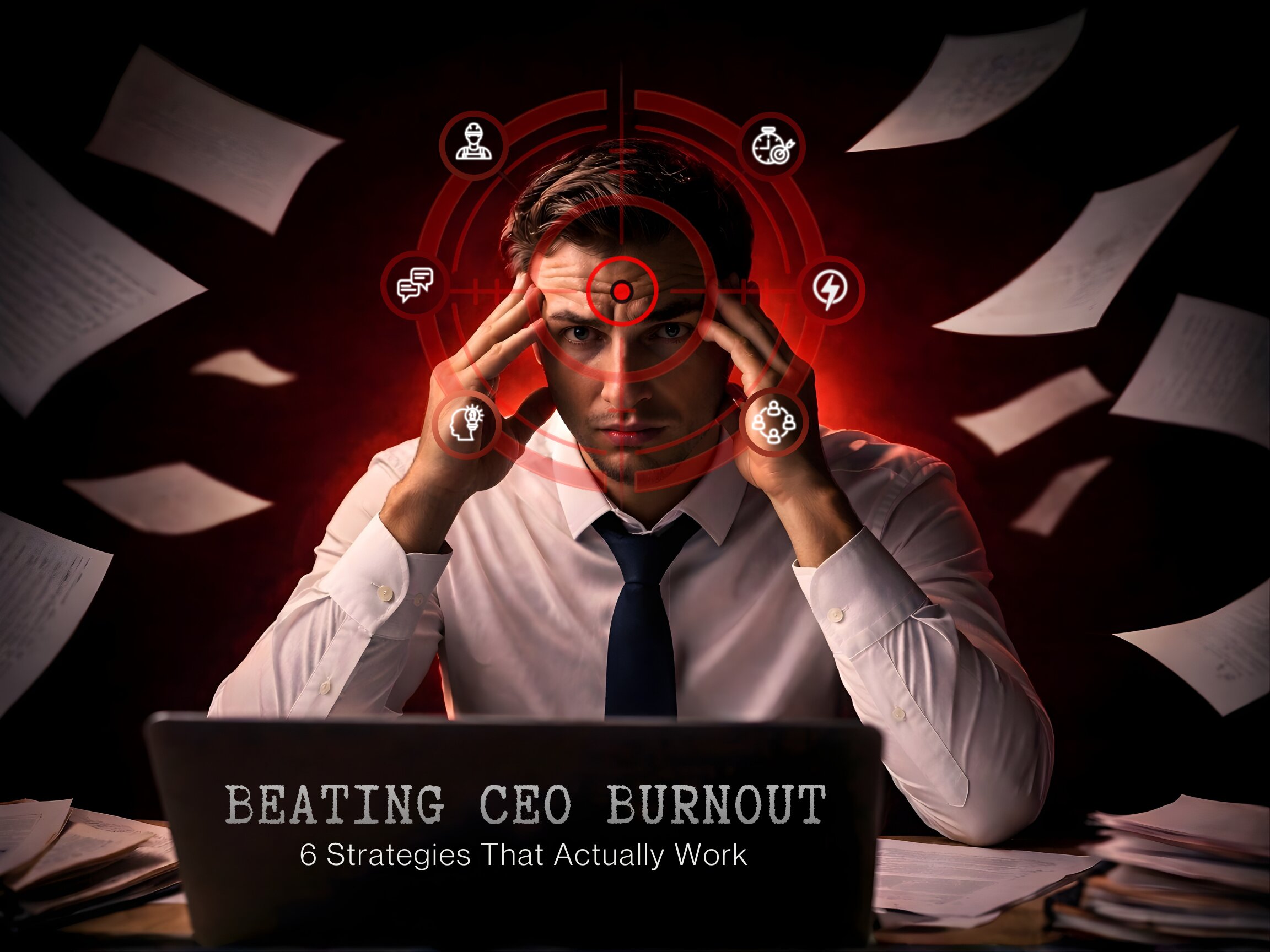
Most CEOs do not burn out because they are weak.
They burn out because the business is still designed to run through them.
That is not a resilience problem. It is an architectural failure.
Burnout at the top rarely looks dramatic.
It looks responsible.
You are in every meeting.
Across every major decision.
Solving problems before they escalate.
From the outside, it looks disciplined.
From the inside, it feels like pressure with no off switch.
If your company can’t run without you for 14 days, burnout isn’t a wellness issue. It’s a design flaw.
You don’t need more resilience. You need redesign.
Not sure it's burnout? Start with CEO Burnout Signs.
The Structural Warning Signs of CEO Burnout
Most CEOs miss the early signs of burnout because performance remains strong.
Revenue is steady. Targets are hit. The calendar is full.
But beneath the surface:
You rework delegated outcomes.
You delay decisions because no one else “sees it clearly.”
You operate in urgency without strategic progress.
You feel isolated despite constant interaction.
You measure effort instead of leverage.
These are not emotional red flags.
They are architectural signals.
Burnout begins when:
Decision velocity slows below you
Escalations route upward by default
Ownership blurs
Execution depends on your presence
When that pattern sets in, you become both a buffer and a bottleneck.
And no company scales through a single nervous system.
Strategy 1: Re-Establish Core Habits & Boundaries
Burnout begins when you become the default answer for everything:
Default approver.
Default problem solver.
Default tie breaker.
As growth accelerates, so does complexity.
If your boundaries don’t evolve, cognitive load will.
Redesign your bandwidth:
Strategic solitude every week
Recovery time protected like revenue
Clear thresholds for decisions and approvals
Your energy is not infinite.
Attention is capital. Spend it intentionally.
Strategy 2: Delegate Power, Not Just Tasks
Most CEOs believe they delegate.
Escalation patterns tell the truth.
If decisions pause at you, delegation has failed.
Shift from supervision to structure:
Explicit decision rights
Pre-defined success criteria
Clear escalation triggers
Then step back.
Control feels safer. Clarity scales faster.
Burnout declines when decision velocity increases below the CEO layer.
Strategy 3: Build a Trusted Peer or Advisor Network
Isolation is an accelerant for burnout.
At the top, fewer people challenge you.
Assumptions harden.
Fatigue starts to feel normal
Blind spots widen.
You don’t need a cheerleader. You need a structured thinking partner.
A peer or advisory rhythm gives you:
Pressure testing before consequences scale
Early detection of burnout patterns
Challenge without politics
The strongest leaders are not the most resilient.
They are the least isolated.
Strategy 4: Prioritise Strategic Thinking Over Reactive Hustle
Reactive leadership feels productive. But it’s rarely strategic.
If your calendar is driven by inboxes and escalations, you’re managing flow, not designing the system.
Redesign your rhythm:
Weekly strategy reviews
Three true priorities, not twelve initiatives
Clear filters for urgent vs important
Avoiding burnout is not about slowing down.
It is about removing unnecessary motion.
Strategy 5: Improve Communication and Team Alignment
Misalignment creates an invisible workload.
When priorities are unclear:
Teams seek validation
Decisions bounce back
Escalation becomes reflex
Every unnecessary escalation is a design failure.
Improve alignment through:
Repeated priority clarity
Explicit trade-offs and “not now” decisions
Cadence that aligns execution with strategy
Effective communication reduces decision fatigue.
Strategy 6: Shift From Operator to Architect
Burnout narrows your lens. You lose altitude and context.
Get above the business:
Reconnect with long-term vision
Invest in second-tier leadership
Define your contribution beyond quarterly metrics
Purpose is not motivation. It is positioning.
Great CEOs stop being inside the machine. They start designing how it runs.
Ready to Shift from Operator to Architect?
The CEO Freedom OS is built for founders who are done being the system—and ready to design one.
Reclaim your time, install second-tier leadership, and scale without burnout.
The CEO Burnout Reset: Don’t Train for Endurance. Redesign for Leverage.
Burnout is rarely solved by working harder or recovering more.
It is solved by redesigning the system so pressure is distributed.
The reset includes:
Removing decision dependency
Installing operating rhythms
Strengthening leadership depth
Reclaiming time for strategic thought
Reducing the noise your leadership absorbs
You don’t eliminate pressure. You distribute it by design.