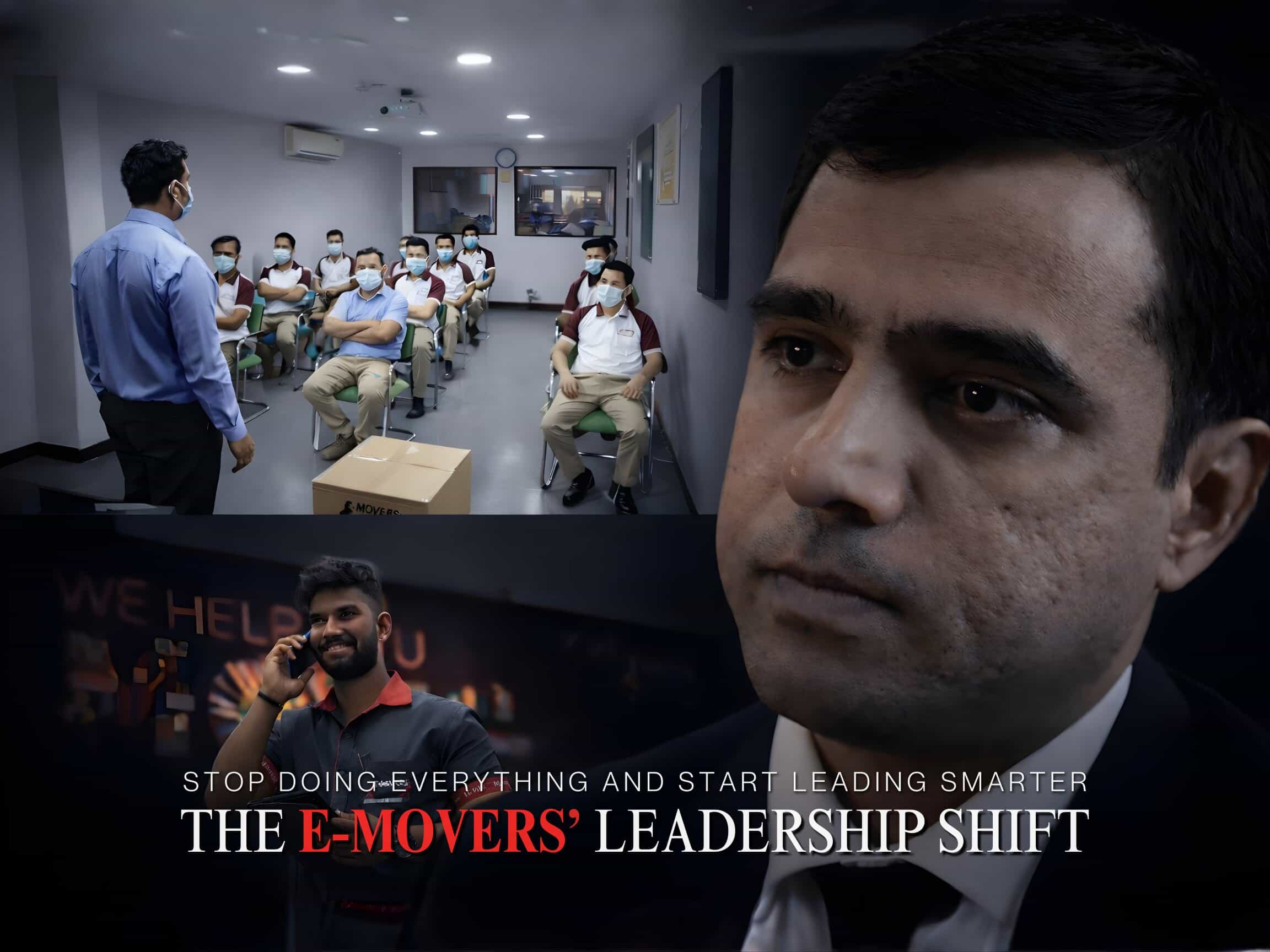
Most scaling problems are not operational failures.
They are leadership control failures.
The uncomfortable truth?
Many founders and senior leaders struggle because they will not let go.
At E-movers, this realisation was not philosophical. It was structural.
Growth increased. Revenue expanded. Complexity multiplied.
But speed slowed.
Not because of market conditions.
Because of leadership gravity.
The Leadership Trap No One Admits To
High-performing leaders often equate involvement with value.
If I am in it, it will be done right.
If I review it, the quality improves.
If I do not delegate the task, we move faster.
That logic works at 10 people.
It breaks at 50.
It suffocates at 100.
Leadership is not measured by how much you execute.
It is measured by how much capability you create.
When leaders cling to control, they do not protect standards.
They cap growth.
When Leaders Become the Bottleneck: The E-movers’ Reality
At E-movers, every key decision moved upward.
Approvals stacked.
Escalations multiplied.
Teams waited.
From the outside, it looked disciplined.
Internally, it was friction.
This is where most scaling organisations stall.
Not from lack of talent. Not from weak systems.
From centralised decision control.
Delegation in business is not administrative hygiene.
It is a structural growth lever.
If every meaningful call requires senior validation, you do not have strategic leadership.
You have dependency architecture.
The Hidden Cost of Doing It All
Leaders rarely see the cost immediately.
Busyness feels productive. But here’s the real cost:
Decision speed drops
Team empowerment erodes
Initiative weakens
Strategic time disappears
Burnout risk accelerates
Over-functioning leaders unknowingly train passivity. That cost compounds.
The Turning Point: From Execution to Strategic Leadership
The shift at E-movers began with a hard question:
“What is the only thing I can do, and what am I doing out of habit?”
Leaders stopped asking,
“How do I make this perfect?”
They asked:
“How do I make this scalable?”
Execution moved down.
Judgment spread outward.
Strategy moved up.
This is where delegation skills become a growth lever. Not a handoff, but a design shift.
What Leading Smarter Looked Like at E-movers
This was not symbolic. It was operational.
1. Decision Rights Were Redefined
Clear authority boundaries.
No default escalation.
No silent approval culture.
Ownership = authority
2. Delegation Was Outcome-Based
Leaders defined the “what,” not the “how”
Outcomes, risk boundaries, and success metrics were explicit
Control reduced. Accountability increased.
3. Strategic Time Became Non-Negotiable
Weekly blocks were reserved for:
Market strategy
Competitive risk analysis
Culture calibration
Growth design
Leadership moved from reactive to proactive.
“I was stuck working in the business, not on it. With Rajesh’s guidance, I empowered my team, created space to think big, and built a culture rooted in trust and ownership. We scaled to 500+ employees, expanded across four countries, and consistently hit 95+ NPS. I now co-create new ventures with leaders I once mentored. And I’ve become a more present father and grounded entrepreneur.”
Chirantan Joshi
Co-Founder, E-Movers
National Director, CorporateConnections® UAE
Culture Signals of Smarter Leadership at E-movers
The change becomes visible when:
Escalation is the exception, not the reflex
Strategic conversations replace operational updates
Leaders transfer judgment by asking for recommendations
Errors are treated as learning data, not leadership failure
This is when leadership qualities mature.
Leaders stop protecting control.
They start building confidence.
And confidence compounds across the organisation.
Why This Shift Matters for Scaling Organisations
Scaling operations is procedural.
Scaling leadership is psychological.
Operations rely on systems.
Leadership relies on identity.
The reason scaling leadership is harder than scaling execution is simple:
Letting go challenges ego.
But without that shift:
Decision bottlenecks increase
Senior fatigue compounds
High performers disengage
Growth plateaus silently
Strategic leadership creates leverage. Leverage creates speed. Speed creates competitive advantage.
A Practical Framework to Apply Now
1. Audit Your Control Footprint
List every recurring decision you are involved in.
For each one, ask: Is this strategic? Or is this habit?
If it is a habit, redesign ownership.
2. Upgrade Delegation
When you delegate, define:
The outcome
The risk boundary
The authority limit
Clarity removes the need for control.
3. Build a Decision Architecture
Explicitly define:
What teams decide
What managers decide
What escalates to you
Ambiguity breeds escalation.
Structure breeds empowerment.
4. Measure Leadership by Leverage
Your success metric is not hours worked.
It is:
How many decisions were made without you
How many problems were solved at team level
How much strategic time you gained
If those numbers are increasing, leadership is scaling.
If not, you are still operating.
The Strategic Risk of Not Shifting
If your organisation cannot move without you, it is not strong.
It is dependent.
And dependency collapses under pressure.
Markets accelerate. Competition sharpens. Talent expects autonomy.
Control heavy leadership does not fail, it erodes quietly.
Until growth slows and you cannot explain why.
The Most Strategic Move a Leader Can Make
The most strategic move a leader can make is subtraction.
Remove unnecessary involvement.
Remove centralised control.
Remove ego attachment to execution.
Then build capability in its place.
At E-movers, the shift did not require new talent.
It required new leadership behaviour.
When leaders stopped doing everything, three things happened:
Decision speed increased
Ownership expanded
Strategic clarity improved
That is what leading smarter looks like.
If your growth feels heavier than it should, the issue may not be operational.
It may be leadership architecture.
That is fixable, but only if you are willing to redesign your role before growth exposes its limits.
Also read: CEO’s Guide: Identifying and Eliminating Growth Bottlenecks